Tory Burch Quilted Style Shop Tory Burch

The Double T and the T Monogram, Cleanly Untangled

Ten shoppers asked to point at the tory burch logo will not all indicate the same thing. One points to the small mirrored emblem cast into the hardware of a sandal. The repeating pattern running across a coated canvas wallet is what one more shopper has in mind. In conversation, in resale listings and in plenty of published writing, both get called “the logo”. The two are unrelated designs, they did not arrive together, and each does a different job. The Double T is the first, and it has been in use since the brand launched in February 2004. The T Monogram is the second: an all-over repeat, reported as having been introduced for Spring 2021. What follows separates the two and shows how to tell on sight which one is in front of you.

The Double T: a single emblem carried since 2004

The Double T is the mark the label launched with in February 2004, the year the founder first opened a first store in Nolita, Manhattan. It is a serif T set against its own mirror image, and the pair sits enclosed in a circle. Written correctly it is “Double T”: capital D, capital T, and no hyphen. Being a single closed mark rather than a tory burch factory outlet pattern is what sets it apart from what came later, and that one property does most of the work. Nor is it a monogram of the founder’s initials: she was born Tory Robinson and took Burch as a married name, so her initials run TR or TB, never TT. The stated intent was a graphic device customers would want to wear, not a signature stamped on a product. That is why the emblem reads as pure ornament rather than labelling.

How the Double T sits on tory burch shoes and bags

Two treatments carry most of the brand’s recognisability, and on tory burch shoes the emblem appears in both. The Reva ballet flat shows it as a cast metal medallion, placed at the front of the shoe. The Miller sandal carries it as a circular laser-cut opening at the toe, punched clean through the leather, with gold rivets anchoring the strap. Across leather goods it is worked into wallets and card cases, and centred on the front panel of the diamond-quilted Fleming bag. In every case the emblem appears once, at a single point on the object. That singular placement is the whole visual argument: the mark is meant to be noticed, then left alone. If it recurs across a surface instead, you have moved to the pattern line that grew out of it.

The T Monogram: a pattern line, reported from Spring 2021

The T Monogram is a separate and much later thing: an all-over repeating pattern built from the Double T. It is reported to have been introduced for Spring 2021, roughly seventeen years after the emblem. The correct written form is two words, capitalised in both cases, with no hyphen. It functions as a named line you can shop as its own category, not as a treatment applied at random. The word “monogram” follows the ordinary industry convention for a repeated house mark; it is not a claim that the design spells anyone’s initials. Because the repeat covers an entire surface, a T Monogram piece can be named from across a room in a way a single cast emblem cannot. That is the difference in one line — the emblem is a detail, the monogram is the material.

The materials that carry the T Monogram

The repeat is found on coated canvas, jacquard, knitwear and small leather goods. Product names read on the brand’s own US site in September 2026 make the construction clear from the wording alone. In accessories the pieces include the T Monogram Coated Jacquard Envelope Small Wallet and the T Monogram Mini Belt Bag. The same naming runs through tory burch clothing, on a T Monogram Jacquard Skirt, a Jacquard Cardigan and a Contrast Cuff Straight Leg Jean. The jacquard naming indicates the pattern is carried in the weave rather than printed on afterwards, which is why those pieces hold it so evenly. Coated canvas gives a finished, wipeable surface, which accounts for how often the pattern appears on wallets and belt bags. Care follows accordingly — coated and woven surfaces should be spot-cleaned with mild soap, and plated hardware dry-buffed only.

The two marks compared

Laid side by side, the differences settle in seconds. One is an emblem, the other a pattern. One dates from the founding year and one is reported from a recent season. One is applied as hardware, a cutout or an emboss at a single point; the other is built into the surface of a fabric or coated canvas. Both are genuine brand marks, so neither is a downgrade of the other, and both run across bags, shoes and ready-to-wear. The table sets out the six differences that matter most when reading a product name or a resale listing.

Point of comparison Double T T Monogram
The nature of it A single emblem: a serif T and its mirror image, in a circle An all-over repeating pattern built from that emblem
When it appeared In service since 2004, which is the founding year Reported to have been introduced for Spring 2021
How it is applied Cast hardware, laser-cut cutout, or embossed leather Woven into jacquard, or carried on coated canvas and knitwear
How many times it shows A single time, at one focal point Continuously, across the whole surface
Where you usually find it Ballet flats, thong sandals, the fronts of quilted bags, card cases Wallets and belt bags, jacquard skirts, cardigans and denim
Correct spelling and case Double T: no hyphen T Monogram, two words, both capitalised

Why the two end up merged in practice

Since the pattern is made out of the emblem, a quick glance registers the same shape twice, and that is the obvious reason. Both get called “the logo” in casual use, and that one word erases the distinction as soon as it is spoken. Resale listings make it worse, because sellers write whatever they think will surface in a search. Published brand histories add another layer: they trace where the emblem came from and then illustrate the piece with a monogram product. Nor does the brand’s own vocabulary help, given that the letter T anchors both names. There is nothing mysterious in any of it; the point is that the word “logo” alone carries no information. Reading the full product name is the fastest available fix.

One mistake worth flagging: David Hicks

The interior decorator David Hicks has been credited repeatedly by the founder as a formative influence, and her Spring 2018 collection was dedicated to him. Hicks was an Englishman, and he lived from 1929 to 1998. At least one widely syndicated account of the logo’s history calls him a Moroccan interior designer, and that is flatly wrong. In those pieces the Moroccan reference hangs on a claim about pattern geometry, not to the man’s nationality, and even that claim is reported rather than confirmed. There is a second story too — that the mark was chosen from roughly two hundred options prepared by an outside firm — and it traces to an interview retelling, so it falls into the same reported bracket. What the emblem is does not change because of any of this, but it does show how much unsourced material attaches to a mark this recognisable. If a source gets Hicks’s nationality wrong, treat the rest of its origin story with equal caution.

What the distinction means at the point of purchase
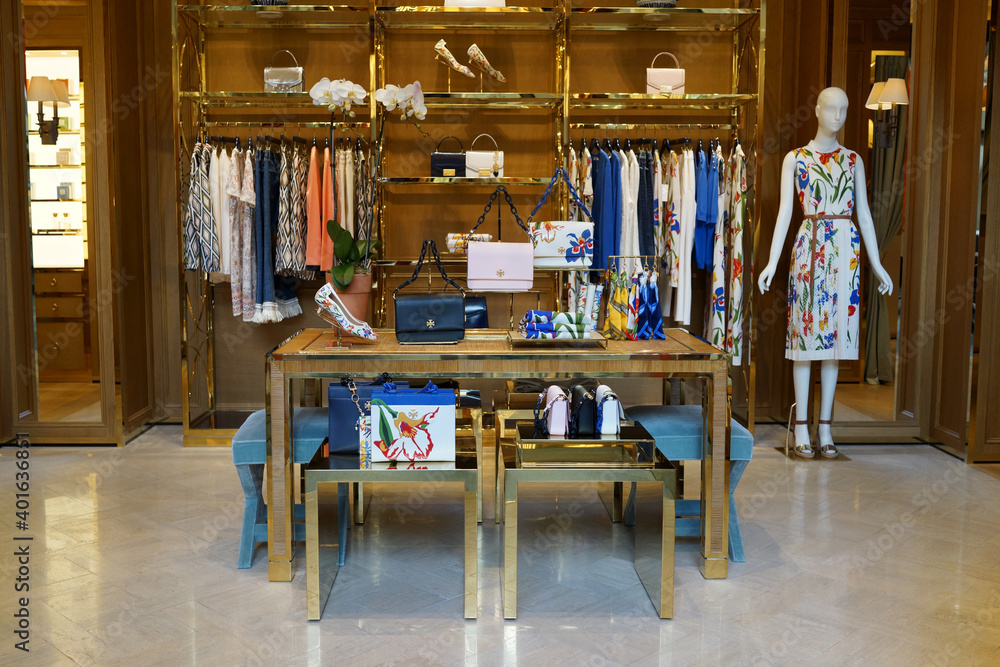
Once the marks are separated, the choice turns on how visible you want the brand to be. A single cast or cut emblem is the discreet option; the pattern is the emphatic one. Observed on the brand’s US site in September 2026, the Miller sandal sat at around $200 and the Fleming Crossbody at about $470. Small leather goods in the monogram ran from roughly $190 to about $310, and monogram ready-to-wear from about $395 to about $550. These are observed market prices and not an official price list; no fixed pricing is published by the brand, and figures move by season, market, material and channel. A tory burch sale changes which pieces are reachable and at what price, but it does not change what either mark is. When checking a listing, read the product name before the photograph.

In brief

An emblem is what the Double T is: two mirrored serif Ts in a circle, carried since 2004, applied once per object. The T Monogram is a pattern — that emblem repeated across a surface, reported from Spring 2021 and sold as its own named line. Neither outranks the other for authenticity, and both are found across bags, shoes and clothing. The confusion is a naming problem, and it resolves the moment you ask whether the mark appears once or many times. In written sources, capitalisation is another useful tell. And when a source also tells you David Hicks was Moroccan, you have learned more about the source than about the brand.

Valentino Designer Purse Valentino Official

Valentino Handbag Prices in 2026: The Real Cost of Each Tier

Valentino bag prices read as chaotic until you set them out in order, and then a clean structure becomes obvious. The current line-up yields observed 2026 figures from $650 to $7,900, with almost every piece falling into one of three tiers that real gaps divide. Knowing which tier you are buying in tells you more than knowing which shape you like, because it forecasts the materials and the volume of surface work you are paying for. The tiers are laid out here, along with the one variable that decides which tier a bag sits in. Every figure here is an observed 2026 market price, not a line lifted from an official price list, because the house publishes no fixed public tariff. Use the tiers as the durable part and the individual figures as a snapshot.

How the numbers work

There are three ground rules that make this guide usable. First, all figures are US dollar prices observed on the brand’s own retail channel during 2026 research, and they describe the market rather than an official list. Second, the ranges inside a single model are genuine and frequently wide, since the same bag in a different material can cost hundreds more. Third: the boundaries between tiers are drawn where the data thins out, not at convenient round numbers. There is a genuine gap between roughly $1,500 and $1,650, and another around $3,600 to $3,700, and those gaps make the tiers meaningful. A listing that falls squarely inside one of those gaps is worth a double-check.

The three tiers at observed 2026 prices

Below, the table shows the structure and gives representative pieces at each level. Treat the left column as your budget decision and the right as the goods that budget reaches. Entry is built from small leather goods; mid holds the bulk of what the house sells; top is almost entirely about surface treatment. How many families appear in the mid tier is the clearest indication of where commercial weight lies. Note too that the top tier reaches more than twelve times the entry price. Once again, these vintage valentino bags are observed 2026 market prices rather than an official price list.

Tier Observed 2026 range (USD) What lives there Example pieces
Entry tier $650-1,500 Wallets, clutches and the smallest of the totes and buckets VLogo Signature clutch $650-790; Rockstud wallet $1,250; Rockstud Mini Shopping $1,390; VLogo mini bucket $1,450
Mid tier $1,650-3,600 The commercial core, holding most current bags across most families Rockstud small crossbody $1,650-1,950; DeVain $2,100; Rockstud Spike small suede $2,550; VLogo Signature Shopping from $2,650; Locò small calfskin $2,700; VSling small $3,350
Top tier $3,700-7,900 Embroidery, crystal and pearl settings, and exotic skins Rockstud Spike embroidered nappa $3,700; Panthea chevron $3,800; Locò with pearls $5,900; VSling with pearls $6,550; Panthea ostrich $7,600; Panthea embroidered $7,900

The entry tier: $650 to $1,500

Smallest by volume and most misunderstood of the three, this is the entry tier. It opens with VLogo Signature clutches in grainy calfskin at $650 to $790 and a moire clutch at $750, the least expensive pieces the house currently offers. Above them sit the Rockstud laminated calfskin wallet at $1,250, the Rockstud Mini Shopping bag from $1,390 and $1,490 in raffia, and a VLogo mini bucket in nappa at $1,450. What they share is scale, not compromise, because they use the same materials and Italian construction found further up. The misunderstanding comes from assuming a cheaper valentino bag is a lesser one, when what you are buying is less bag. The Rockstud wallet, in particular, puts within reach the house signature for under half the price of a shoulder bag.

The mid tier: $1,650 to $3,600

Nearly everything the house sells lives here, and it is where a serious buyer should expect to land. It opens with the Rockstud small crossbody at $1,650 to $1,950 and the Rockstud small shoulder bag at $1,950 in suede and $2,100 in grainy calfskin, then takes in DeVain from $2,100, Rockstud Spike from $2,550, VLogo Signature shopping bags from $2,650, Locò from $2,700 and VSling from $3,350. Six families occupy roughly two thousand dollars of range, which is unusually dense. The effect is that the choice here turns on design language rather than budget, since a Locò and a Rockstud Spike can cost the same. And a few hundred dollars either way genuinely changes what you can reach. If you are shopping valentino bags to a defined budget, map this tier first.

Top tier: $3,700 to $7,900

The pricing logic changes above $3,700, where it stops being about the bag at all. First up are a Rockstud Spike medium in embroidered nappa at $3,700 and a Panthea in chevron nappa or suede at $3,800. Decoration and skin take it from there: embroidered Locò pieces at $4,700 to $5,100, a Locò with pearls and rhinestones at $5,900, a mini VSling with pearls at $6,550, Panthea in python at $5,650 and ostrich at $7,600, and an embroidered Panthea at $7,900. Not one of those increases buys extra capacity, and several buy less. Professional care is a requirement for python and ostrich, so exotic skins bring an ongoing cost as well. This tier sells craft and spectacle, and should be judged on those terms.

What genuinely moves the price

One point above all the others: material and embellishment set the price, while size barely matters. Family by family, the evidence holds up. Observed figures put a DeVain small shoulder bag at $2,100 in jacquard lurex and $3,900 in metallic mesh, an $1,800 gap at the same stated size. A Rockstud Mini Shopping bag runs from $1,390 in grainy calfskin to $1,850 in pony-effect calfskin with no change in model or dimensions. Most strikingly, a mini VSling with pearls at $6,550 costs almost twice a small VSling in grainy calfskin at $3,350, so the smaller bag is the more expensive one. Read the material description rather than the model name, then, whenever you are comparing two listings.

Sales, outlets and what a genuine discount looks like

Official seasonal sales do run on the house’s own retail channel, and there are dedicated sections for women’s and men’s bags and accessories. Because the US sale page as of September 2026 stated the Spring/Summer 2026 sale had ended, a valentino bag sale is periodic rather than permanent, and the structure’s references to private sales point to an invitation-gated mechanic. Physical outlet shopping exists too, with the brand present at The Mall Firenze in Tuscany, which sells ready-to-wear and Valentino Garavani accessories, and a store reported at Fidenza Village. What is not verifiable is the depth of those discounts, the sale calendar, or whether outlet stock is made for outlets, so treat percentage claims with suspicion. Deep permanent discounts on current-season stock are the clearest sign of a site that is not what it claims, particularly where a name is padded with words like outlet, sale or store, or with a country suffix. Note as well that off-price chains including Nordstrom Rack, Saks OFF 5TH and TJ Maxx carry Valentino by Mario Valentino, which is a different company entirely.

What happens to the money afterwards

The other half of the price question is resale, where the verified numbers are sobering but not bad. Retention for Valentino handbags overall comes out near 41 percent of original price on marketplace data, the best styles between 50 and 58 percent. Tracked examples run to a Roman Stud flap at 58 percent, a VLogo Locò flap shoulder bag at 57 percent, a Rockstud drawstring bucket and a Rockstud flip lock flap at 56 percent, and a Rockstud pouch crossbody at 50 percent. One figure, from a single source, puts a medium Rockstud Spike at resale near $1,700 against roughly $2,900 new. Pre-owned Valentino Garavani pieces on one aggregator run from $54 to $6,300 and average around $817. The pattern is clear enough — instantly recognisable motif bags hold value best, and the house sits mid-table rather than at the top.

Prices worth pausing over

A price can be wrong for reasons that have nothing to do with a dishonest seller. The commonest issue is an archive model priced as current: Roman Stud, One Stud, Supervee, Escape and Stud Sign are all absent from the brand’s filters and belong to resale or clearance rather than the live range. A small Roman Stud handle bag observed at $3,550 was marked reserved rather than orderable — exactly the kind of listing that gets copied elsewhere as a current price. Second comes company confusion, since a bag from Mario Valentino of Naples is authentic yet comes from a separate, unrelated business at a different price point; only the couture house’s pieces carry VALENTINO GARAVANI on the interior tag. The third issue is authentication folklore, because there is no date-code system here, and a serial number on an interior tag, though common, is not universal, so its absence proves nothing. Establish which company, which era and which material before you judge whether a figure is fair.

Ferragamo Premium Handbag Ferragamo Tote Bag

Ferragamo Bags: A Complete Walk Through the Range

A Ferragamo bag comes to mind at once yet refuses to be summed up neatly. In September 2026 the brand’s own United States webstore carried 279 handbags, led by roughly ninety top handles and running down through minis, clutches, crossbodies and totes. Rather than reproducing a catalogue, this guide follows how the collection behaves: one headline silhouette, architectural families set around it, an accessible hardware line below it, and a thin exotic tail. The figures below are observed 2026 market prices, taken on one day rather than an official price list. The house is Florentine, seated at Palazzo Spini Feroni; it trades on Borsa Italiana as SFER and has had Maximilian Davis as creative director since March 2022. Take the sections below as a map rather than an inventory.

Where the bags came from

This house’s leather goods are its newer half, and that is where a proper reading starts. Salvatore Ferragamo built the business on footwear from 1927; bags arrived in 1965, when Fiamma Ferragamo began designing handbags and small leather goods as accessories to the shoes, and the first press article featuring a Ferragamo bag is dated 1969. Everything after that is bag history. Drawn up beside a wardrobe that already had a point of view, they are organised around a closure rather than a logo. Structure arrived with them: the panels are formed and held, the edges finished cleanly, and most silhouettes hold their shape when empty. From 1967 design and prototyping ran out of the Osmannoro facility near Florence, and “Made in Italy” still appears on every current bag page.

The Hug, and why it sets the tone

Right now the collection is defined by one design: the label’s own craftsmanship pages call the Hug its modern accessory icon. A rigid and asymmetrical top handle, it has side panels that fold inwards under wrap straps fastened with two golden Gancio buckles, which makes the closure the ornament as well. Sizes run XS, M and L, materials run calfskin, suede and raffia, and there is normally a detachable strap plus a keychain charm on the zip ferragamo crossbody bag ring. Around that core sits a sub-family: a slouchy Hug Soft shoulder bag, a bicolour Hug Soft, an elongated Hug East-West and a Hug mini crossbody. Observed prices show the XS at $2,500 to $2,650, the medium at $3,400 to $5,700 and the large at $3,600 to $3,900. That spread is why the Hug turns up in almost every corner of the assortment.

Cara, Studio and the hard-edged shapes

The structured side of the collection is owned by the Cara and the Studio families. The Ferragamo Cara is the newest, a slim architectural shoulder bag in XS and S with a Gancini closure, and it is the Fall/Winter 2026 push, placed first in the site’s hero navigation. At an observed $3,400 for the XS and $3,700 for the S, it is a bag to assess by its line rather than for capacity. The Studio Bag is the house’s standing architectural collection and splits in two. The Studio Box is a structured top handle with a Gancini clasp in soft calfskin at $2,550 to $3,100; the Studio Soft is rounder and more voluminous in hammered leather, canvas or raffia effect, at $3,200 to $3,600. The Iconic Top Handle sits with them: a small accordion-sided shape the house describes as a re-release of one of its best-known styles, made in leather or hand-woven wicker with silk lining.

Soft shapes, totes and evening

The soft side, not the architectural one, is where most everyday carrying in this collection takes place. The Ferragamo Soft-bag is what its name suggests, an unstructured shoulder bag observed at $2,100 to $3,500 in small and $2,950 in medium. Newest on the soft side is the Sofia 2026 shoulder bag at $2,700 in medium and $3,200 in large, and Sofia is the official spelling although one retailer files it as “Sophia”. Totes cover the practical end, with the Mia in large at $2,400 to $5,700 and the folded tote at $1,850 to $2,100. Evening falls to the Diana clutch at $2,200 to $4,500 plus a mini clutch family from $1,650. A hobo appears at both ends of the ladder, the XS at $1,090 and the medium at $4,300.

The Gancini family and where you come in

The hook motif is the heritage anchor and, in practice, the most affordable way into the house. There is hard evidence of its first appearance rather than guesswork: Women’s Wear Daily published a photograph of a Ferragamo bag with a hook-shaped metal closure in 1972. Today it works as a functional clasp, as cast hardware and as an embossed or outlined pattern across leather and jacquard. The Double Gancini group is where most first purchases happen, with a top handle XS at $2,500, crossbodies from $2,400 to $2,900 and one observed as low as $830, and a clutch at $880. One step up sit a Gancini chain mini at $1,850 and an outline tote at $1,750 to $1,850. At the head of the family is a medium Gancini handbag in python with golden hardware and suede lining, observed at $4,100.

The price architecture

Taken as a whole, the price architecture is steadier than the headline numbers suggest. The working range for a current bag is roughly $830 to $4,800, with an exotic tail above that most shoppers never meet. The recognisable Hug begins between $2,100 and $2,500 depending on the variant, putting the most identifiable design well below the ceiling. Gancini hardware occupies the floor, Studio and Soft take the middle, and the Cara and larger Hugs mark the upper band. Material moves a bag between bands as much as size does, because the same silhouette in python can multiply its price several times. The table groups those observed 2026 market prices; they were recorded on one day and are not an official price list.

Tier Representative models Observed 2026 market prices
Entry level Double Gancini clutch and crossbody, wallet on a chain, hobo XS, bucket with multiple pockets $830 to $1,500
Main body Tote, mini, Gancini outline tote, folded tote, Soft-bag, Hug East-West, Hug mini and XS $1,650 to $3,500
Upper Cara, Hug L, Hug Soft L, python Gancini, Iconic Top Handle, Mia tote L $3,400 to $5,700
Exotic tail Hug XS in exotic leather, Iconic Top Handle S, Diana clutch, Studio Box S $7,500 to $24,000

Materials, hardware and construction

The composition fields on the brand’s product pages are plain-spoken and tell you most of what matters. Calfskin shows up in two personalities, smooth and grained or hammered, and the grained version absorbs a season of real use far better. Suede runs through the Hug family and photographs beautifully, but it is the most weather-sensitive surface in the range. Python sits at the top of the ladder and appears rarely. Character in the warm-weather assortment comes from the woven materials, hand-woven wicker with silk lining, raffia, canvas and jacquard. The hardware is predominantly gold-tone Gancio; every current page carries “Made In ITALY”; and no public care guide is published by the house, whose only official aftercare is Repair Services requested at selected boutiques.

Where to buy: shops, sales and the outlet question

Ferragamo sells through its own regional webstores and around 354 stores in the official locator, and supplies verified stockists including Nordstrom, Bloomingdale’s, Saks Fifth Avenue, Mytheresa and Farfetch. Rather than undercutting, authorised retailers respect recommended prices: one has a small Hug East-West at $2,500 and a medium raffia Hug at $3,400, matching the label’s own figures. A Ferragamo sale genuinely exists, in the form of seasonal sale sections on the label’s own site, though in the between-seasons window of early September 2026 no sale link showed in live navigation. Care is needed with the Ferragamo outlet question, since the label does run stores inside outlet villages, from The Mall Firenze near Florence to a dozen or more Simon Premium Outlets locations, while its own locator labels none of them “Outlet” and no official online outlet exists at all. That is the most useful thing to carry into a browser, since any site presenting itself as an official online outlet is not the brand. The house reports removing 107 fraudulent websites and 89,136 counterfeit listings for 2022 alone, and its published instruction is to buy from its website, a Ferragamo shop or an authorised distributor.

Picking one

Begin from how you carry rather than from the name on the label. If you want the design most associated with the house today, the Hug in XS is the quickest way in, and its verified measurements are honest: height 5.5 inches, length 8.8 inches, width 4.3 inches, a strap of 21.7 inches and a handle drop of 2.9 inches. If you want the heritage without the outlay, a Double Gancini piece puts the motif in your hands at the bottom of the ladder. If you need capacity, the Mia or the folded totes make more sense than a larger Hug. If you want something unlike the rest of the range, the Cara is the current statement. One practical note for pre-owned hunting: resale platforms still file all of this under Salvatore Ferragamo, so try both names.

Liberty Camo Hoodie GS Godspeed Jacket

Godspeed on the Resale Market: What Actually Holds Value

Of everything surrounding Godspeed, resale produces the most faulty reasoning. Because the label works in small batches and a handful of jackets carry numbered tags, it is easy to conclude that everything appreciates. That reading is not supported by the observed 2026 data. A major resale platform’s brand page displayed about forty apparel entries, with lowest asks covering roughly $75 to $297. Set that against retail hoodies at $200 to $270 and t-shirts at $128 to $200, and the conclusion is unavoidable: a large share of the line trades below what it originally cost. Everything below describes observed market behaviour rather than investment advice, and none of it should be treated as a forecast. On the secondary market prices drop as readily as they climb, and a Godspeed piece can be worth less a week after you buy it.

How the Resale Market Actually Works

Because Godspeed sells both through its own webstore and through wholesale, inventory arrives in front of buyers by several paths simultaneously. Stockists observed in 2026 included FEATURE, TAKOUT NY, Tops and Bottoms USA, Civilized Nation, Premium Lounge NY, NRML in Ottawa, Farfetch and GOAT. That spread matters, because a piece sold out on the brand’s own site may still be on a shelf somewhere else at full price or discounted. Resale only becomes the cheapest route once every retail channel is genuinely dry. Secondary-market sellers price against that shifting backdrop, not against a fixed retail figure. Understanding where a given piece sits in that supply picture explains most of what looks like random pricing.

Where You Will Find the Listings

In 2026 the bulk of visible Godspeed resale activity was spread across three venues, each with its own behaviour. One is a large sneaker-and-apparel marketplace, whose brand page carries structured entries, size-by-size asks and a lowest-ask figure per item. A community-driven designer marketplace puts individual sellers on the page, so prices scatter more widely and negotiation is normal. The rest turns up on a speedoutlet.org general auction site, which also carries pieces that never reach the other two. None of these venues is a price authority, and the same garment can show three very different numbers on the same day. Read each listing as one seller’s opinion, not as a market rate.

  • Structured marketplace: consistent data, tighter spreads and fees already folded into the ask
  • Seller-led marketplace, where prices scatter, offers are welcome and condition varies
  • Auction site: the widest asks, including several that never sell

How to Read a Lowest Ask

What a lowest ask shows is a seller’s hope, not a completed payment. This single distinction explains most bad resale reasoning about Godspeed. One varsity jacket was seen asking $595 on an auction site in 2026, and that number is a seller’s ask, not a retail price and not a completed sale. Nothing stops an unsold ask sitting untouched for months while the true clearing price drifts far below it. Sale history, where a platform publishes it, is far more informative than the headline number. If there is no sale history, work on the assumption that real value sits under the ask and set your offer from there.

What the Numbers Showed in 2026

Below, observed retail bands sit alongside the way each category behaved once it reached resale. All figures are 2026 market estimates observed at a single point in time, not published price lists and not guarantees. They have almost certainly moved since. The pattern is consistent enough to be worth describing: outerwear and scarce graphics hold firmest, core basics soften fastest, and accessories land somewhere between the two. Nothing in this pattern is a promise about any individual item. That two identical hoodies in different sizes routinely clear at different prices says plenty about how thin the market is.

Segment 2026 observed retail (USD) Observed behaviour on resale
Varsity jackets, numbered Retail unrecorded; pages already sold out Strongest demand observed; asks well clear of other categories
Pullover hoodies $200-270 Mixed picture; common graphics often sit under retail
T-shirts and tees $128-200 Softest segment; a lot of asks land in the $75-120 area
Sweatsuits and sets $155-360 Splits by completeness; broken sets discount hard
Denim, premium around $250 Few listings, and very few comparable sales
Caps and headwear $60-150 Consistent but low in absolute terms
Belts and slides $250 and $160 Rarely listed, and pricing is unreliable

Pieces That Tend to Hold

What separates the pieces that keep their number from the ones that do not comes down to a few characteristics. Verifiable, garment-level scarcity is the strongest factor, so the numbered varsity jackets lead. Stated runs of 200 units produced the F.T.D and Chrome Seduction varsities, each with a numbered authenticity tag. Named collaborations behave similarly, with the collection made with The Lox drawing interest beyond the label’s usual audience. Heavy build helps, as wool bodies, vegan-leather sleeves, 3M reflective detailing and dense embroidery are difficult to confuse with a plain blank. A stockist’s editorial coverage stated the production philosophy plainly, describing drops as intentionally limited and produced in small batches to preserve the integrity of the design.

  1. Garment-level scarcity you can actually verify, a numbered run being the clearest case.
  2. A named collaboration that brings its own audience.
  3. Construction other makers cannot cheaply reproduce.
  4. A colourway already thin on the ground at retail.

Which Pieces Tend to Soften

The other end of the curve is where most of the catalogue lives, and it is not a criticism of the product. Godspeed shirts are the clearest example, since they were produced in the widest colour and graphic assortment. When lowest asks open near $75 against a $128 to $200 retail band, the market is saying supply exceeds demand at retail pricing. The fastest to soften are core basics in black and bone, restocked and reinterpreted across seasons. Shorts and nylon pieces follow a seasonal curve, thinning out in autumn and recovering in spring. Whatever the original ticket said, a godspeed hoodie with a widely repeated graphic behaves like a basic rather than a limited jacket.

Condition, Tags, and the Numbered Runs

More of the final number rides on condition than most buyers expect. The weak point on a printed piece is puff print: heat and pressure flatten or crack it permanently. Grading gets harder with garment washes too, given that a black wash or grey wash finish is supposed to look faded from day one. Ask sellers directly whether fading is original to the wash or the result of laundering, and request close photographs of print edges. On numbered jackets, the authenticity tag is part of the value, and a missing or cut tag reduces what a careful buyer will pay. Original packaging matters less here than in sneakers, but a complete piece still clears faster than an incomplete one.

Sizes, Fit and the Discount They Create

Size curves distort resale prices in ways that catch people out. The cut is boxy and oversized by design, which pushes buyers toward the middle sizes and strands the extremes. Extra-large and small pieces frequently carry the lowest ask on a given item, which looks like a bargain until you try wearing it. A godspeed hoodie sized two steps off your normal fit is not a saving, it is an unworn garment. Buying to wear? The size discount is genuinely useful, since the cut runs large regardless. If you are buying to resell, the same discount is a warning that the size is slow.

The Risk, Spelled Out

Nothing here is guaranteed, and it is worth saying so bluntly. Godspeed resale prices can and do fall, and in 2026 a substantial share of the line already sat below its original retail figure. A restock, a markdown at a wholesale partner or a fresh drop in a similar colourway will each pull secondary prices down. Producing in small batches supports scarcity, though scarcity becomes value only when there is demand to meet it. The article sets out what was observed, not what is coming, and no garment should be treated as a financial instrument. Where a purchase makes sense only on the expectation of selling higher later, that is a reason to stop and reconsider, not to proceed.

A Saner Way to Buy

The safest approach is simple: buy only what you would be content to keep. Set a number you would pay if resale did not exist, and treat any future upside as an accident rather than a plan. Look at retail channels before anything else: a wholesale partner with old stock on markdown beats almost any resale ask. Line up at least three listings from different venues before committing to one. Check that you are dealing with a genuine retail source and not one of the many lookalike storefronts recycling the brand’s imagery. Buy the piece for the fleece, the wash and the graphic, and let the market do whatever it is going to do.

Street Style Wear Order Today

A Buyer’s Roadmap to Palm Angels Original Apparel

Purchasing Palm Angels apparel is an expenditure in superior materials, design, and fashion relevance. Whether you are a new buyer intrigued about the buzz or a dedicated aficionado growing your rotation, exploring the world of Palm Angels requires a adequate level of information to make wise spending decisions. This resource addresses everything from comprehending the brand’s product categories and pricing model to checking pieces and landing the most attractive deals. The luxury streetwear market hit an estimated $165 billion globally in 2025, and Palm Angels remains one of the most in-demand labels within that market. Making an smart transaction means appreciating what makes this name apart, where to purchase, and how to confirm you are getting authentic product every individual time. With counterfeits filling digital marketplaces and resale prices changing by the week, the advice in this manual could rescue you hundreds of dollars and a tremendous deal of hassle.

Understanding the Palm Angels Clothing Range

Palm Angels features a wide-ranging lineup of menswear, womenswear, and kidswear across multiple product lines. The main menswear line comprises designer tees, hoodies, track pants, outerwear, denim, shorts, and knitwear, while extras span bags, hats, belts, jewelry, sunglasses, and footwear. Womenswear follows a comparable structure with added where to find palm angels clothing online categories like dresses and skirts that feature the house’s characteristic streetwear aesthetic. Each season, the label launches about 250 to 350 separate SKUs across these groups, meaning there is a considerable selection of options at any given time. The product offering is divided into mainline pieces (stocked at authorized retailers worldwide), capsule collections (limited-edition drops tied to collaborations or exclusive themes), and exclusive items (available only through the house’s own stores and website). Recognizing which category a piece lands into is vital because it substantially influences availability, pricing, and resale value.

The house’s most famous and enduringly sought-after items consist of the iconic track suit (jacket and pants sold separately, generally $450 to $650 per piece), the logo-print crewneck tee ($275 to $395), the bear motif hoodie ($595 to $750), and the PA monogram accessories. These items make up the core of the Palm Angels identity and are refreshed seasonally with refreshed colorways and slight design tweaks. Runway pieces lean to be more bold in design and are created in tighter quantities, making them more coveted on the second-hand market but harder to find at retail. If you are a beginner to the label, beginning with a staple piece is normally the smartest approach — you get a sense of the construction and aesthetic without the stress of hunting a limited drop.

Where to Get Real Palm Angels

Authorized Platforms and Authorized Partners

The safest way to shop for Palm Angels garments is through the brand’s official website at palmangels.com or one of its 12 standalone stores in cities including Milan, New York, Tokyo, London, Las Vegas, and Miami. Shopping straight from Palm Angels ensures legitimacy, provides access to the whole current-season catalog, and often encompasses special items not found elsewhere. The website offers international shipping to over 80 countries, with standard delivery times ranging from 3 to 10 business days depending on location. Returns are permitted within 14 days of delivery for new items with tags intact, which is quite standard for luxury fashion. Beyond the brand-owned channels, Palm Angels keeps wholesale alliances with dozens of authorized platforms including SSENSE, Farfetch, Mr Porter, Selfridges, Saks Fifth Avenue, Neiman Marcus, and Browns. These stockists carry edited selections of each season’s offering and commonly present seasonal deals — normally 20% to 40% off — during end-of-season sales periods, which fall in June/July and December/January.

When browsing through authorized sellers, always verify that the retailer is included on Palm Angels’ dedicated stockist page or is a recognized luxury fashion platform. The Palm Angels official website provides a store locator that identifies all authorized physical and online stockists. Purchasing from unapproved sellers opens up major risk of being sent replica products, even if the price seems fair. A common trick used by knock-off sellers is pricing items just 10% to 15% below retail to feel authentic while still going below authorized channels — if a deal looks surprisingly good but not obviously cheap, it may still be a replica. Staying with trusted, authorized retailers nullifies this risk entirely and confirms you get warranty protection and customer service support should any difficulties come up with your purchase.

Buying on the Resale Market

The second-hand market is a major avenue for purchasing Palm Angels, specifically for depleted items, past-season pieces, and limited-edition collaborations. Platforms like StockX, Grailed, Vestiaire Collective, and The RealReal are the most respected options, each including some form of verification service. StockX uses a impartial marketplace model where all items pass through a physical authentication center before being dispatched to the buyer, making it potentially the safest resale option. Grailed offers a peer-to-peer marketplace with community-based credibility systems and seller verification. Vestiaire Collective features in-house authentication for items above a defined value threshold, while The RealReal oversees consignment with specialized authentication teams. Resale prices for Palm Angels differ greatly depending on the piece, its wear level, and its scarcity. Staple items like standard logo tees usually resell at 90% to 110% of retail, while special collaboration pieces can achieve premiums of 150% to 300%. Before buying on the resale market, always investigate the item’s launch retail price, compare multiple platforms for price benchmarking, and diligently review seller reputation and return policies.

Seller Authentication System Purchaser Protection Mean Price vs. Retail Return Terms
Palm Angels Official Direct (guaranteed) Comprehensive manufacturer warranty 100% (retail) 14 days
SSENSE / Farfetch Authorized retailer Complete buyer protection 100% (sales possible) 14–30 days
StockX Hands-on authentication center Money-back guarantee 90% – 200% No returns (verified items)
Grailed Community + optional verification PayPal protection 80% – 180% Seller-dependent
Vestiaire Collective In-house for high-value items Consumer protection program 70% – 150% Condition-dependent

Authentication and Sidestepping Counterfeits

Critical Authentication Indicators

Counterfeit Palm Angels pieces have grown ever more advanced, making authentication a essential capability for any buyer. Genuine Palm Angels clothing include several distinctive quality indicators that are tough for counterfeiters to reproduce flawlessly. First, check the tags: legitimate pieces contain a main identity label with neat, precise stitching, a care label with extensive washing instructions in multiple languages, and a separate size tag. The font used on all labels should be matching and defined — unclear text, variable spacing, or misspellings are obvious red flags. Second, evaluate the fabric weight. Palm Angels uses top-grade materials acquired from Italian mills, and the heft and hand-feel of real pieces are visibly better to counterfeits. A real Palm Angels cotton tee typically weighs between 220 and 280 grams per square meter, while fakes often use thinner, rougher cotton that is noticeably substandard to the touch. Third, inspect the hardware. Zippers should be branded (commonly YKK or custom Palm Angels pulls), drawstrings should have proper aglet tips, and any metal hardware should register as solid rather than flimsy or lightweight.

Print precision is another solid authentication clue. Palm Angels artwork prints are created using high-resolution screen printing or digital transfer techniques that produce sharp, rich images with true color intensity. Replica prints often come across as noticeably muted, crooked, or show visible dot patterns when studied up close. The brand’s iconic flame and palm tree visuals have very precise ratios and color blends that counterfeiters regularly get off. If you are buying a high-value piece and have any uncertainty about authenticity, look into using a dedicated authentication service like Legit Check or CheckCheck, which offer photo-based verification for a fee of $5 to $30 per item. These services utilize qualified authenticators who can identify fine differences that may be unnoticeable to untrained eyes. Putting a minimal amount in verification can avoid a far bigger economic loss on a knock-off purchase.

Sizing and Fit Tips

Palm Angels sizing fits slightly oversized compared to conventional European and American sizing, which is deliberate given the label’s streetwear aesthetic. Most customers experience that their regular selection provides a pleasant, slightly loose fit, while sizing down one creates a more streamlined silhouette. The label uses Italian sizing conventions for some pieces and international sizing (XS through XXL) for others, so always reference the particular size chart available on the product page before checking out. For reference, a Palm Angels size M in tees and hoodies relates broadly to a US Medium/Large or EU 48-50, with chest measurements typically ranging from 108 to 114 centimeters. Track pants incorporate an elastic waistband with drawstring, offering more versatility, but the inseam length inclines to be generous — if you enjoy a shorter look, think about sizing down. Womenswear pieces replicate a parallel slightly-oversized sizing strategy, though the womenswear line provides more fitted options in certain categories.

When browsing online, make use of the thorough size references listed on platforms like SSENSE and Farfetch, which often offer garment-specific measurements rather than generic brand sizing. Browse customer feedback for fit advice, giving careful attention to commenters who disclose their height, weight, and the size they bought. If you are between sizes, requesting two sizes and sending back one is a sensible option when buying from stores with accommodating return policies. Given that Palm Angels pieces entail a substantial financial outlay — with average basket values ranging from $400 to $1,200 — nailing the sizing right on the first buy circumvents the inconvenience and cost of returns while making sure you enjoy wearing your fresh piece from day one.

Planning Your Purchase for Top Savings

Savvy timing can spare you a significant amount when purchasing Palm Angels. The house runs on a conventional fashion calendar with two main collections per year — Spring/Summer and Fall/Winter — plus inter-season capsule drops. Latest collections usually land at retailers between January and March (SS) and July and September (FW). End-of-season sales at authorized retailers commonly commence six to eight weeks after a range launches, with starting discounts of 20% to 30% deepening to 40% to 50% as the sale period progresses. However, sought-after sizes and styles go swiftly once markdowns start, so holding off for the maximum discount means living with a smaller selection. The perfect timing for most buyers is the initial markdown period, where you can secure in-demand pieces at a significant discount before sizes become scarce. Private sale opportunities, which many luxury retailers provide to newsletter subscribers and loyalty program members, sometimes give early access to markdowns — registering for email lists at SSENSE, Mr Porter, and Farfetch is a zero-cost way to gain this edge. Finally, keep in mind that Palm Angels’ most classic core pieces are renewed frequently, so there is almost never a reason to purchase at full price unless you have your mind set on a certain seasonal colorway or limited collaboration piece that will not return.

Mes Erreurs les Plus Marquantes au Sankra Casino : Enseignements pour les Amateurs Français

Nous avons tous commis des fautes en jouant en ligne. Mon expérience au sankracasino, en dépit de son offre de jeux et ses offres promotionnelles, n’y a pas échappé. Je désire partager avec vous mes erreurs les plus marquants, ces derniers qui m’ont valu de l’argent et un peu de ma quiétude. Ce n’est pas une remise en cause du casino, mais un témoignage brut. En comptant que ces histoires vous serviront à jouer de façon plus avertie et plus maîtrisée. Que vous soyez un joueur régulier de Sankra ou juste en train de rechercher un casino en France, ces enseignements peuvent vous concerner.

Oublier les Règles des Promotions

Ma toute première erreur, et la plus coûteuse, a été de appuyer sur “Accepter” sans jamais lire les Conditions Générales. À Sankra Casino, les bonus de bienvenue et les spins gratuits sont liés à des exigences de mise très rigoureuses. J’ai appris à mes pertes qu’un bonus de 200% avec un wager de x35 est bien loin d’être un cadeau facile à récupérer. Ces dispositions détaillent les jeux éligibles, leur contribution au déblocage et les maximums de mise. La réglementation française exige de la clarté, mais c’est au joueur de prendre le temps de parcourir. Mon négligence a fait s’évaporer plusieurs profits envisageables, simplement parce que je n’avais pas respecté le accord.

Continuer à Perdre pour “Se Rembourser”

Le piège est connu, pourtant on y cède toujours. Après une série noire sur un slot, je me suis dit que le prochain spin allait tout récupérer. Cette quête de remboursement, motivée par la frustration, aggrave les choses. Chez Sankra Casino, où les parties s’enchaînent vite, la dérive est rapide. J’ai dû me rappeler que le casino possède un avantage mathématique, toujours. La conclusion est simple : établissez une limite de pertes, que ce soit pour la journée ou la semaine, et tenez-vous-y. Les dispositifs de jeu responsable, à l’instar de la limitation de dépôt, existent pour ça. Sur le territoire français, on doit les utiliser.

Négliger la Gestion de Bankroll

Miser sans plan, c’est comme rouler les yeux bandés. Pendant des mois, j’ai versé de l’argent d’après mon état d’esprit, sans nulle méthode. Un profit me rendait téméraire, une perte me forçait à miser le surplus pour “me refaire”. Pourtant, la administration de bankroll est la compétence primordiale. Cela implique consacrer une montant que vous êtes prêt à perdre, et la scinder en petites unités de jeu. Par illustration, ne en aucun cas mettre en jeu plus de 5% de ce capital sur une seule séance. Quand j’ai appliqué cette rigueur à Sankra Casino, mon endurance et mon satisfaction se sont clairement perfectionnés.

Se Spécialiser dans un Unique Type de Jeu

Je suis tombé dans une impasse. Fasciné par les graphismes et les cagnottes des machines à sous, j’ai entièrement négligé le blackjack et la roulette. Cette fixation m’a retiré de deux éléments. Premièrement, certains jeux de table ont un RTP (Retour au Joueur) plus avantageux que les slots. Par ailleurs, diversifier les plaisirs prévient la fatigue, qui conduit à des paris imprudents. La bibliothèque de Sankra Casino est vaste. Explorer différents mondes avec de petites mises est un bon moyen d’apprendre et de se trouver de nouvelles inclinations.

Ne Pas Profiter des Programmes de Fidélité

Pendant longtemps, je n’ai pas prêté attention au programme de fidélité de Sankra Casino. Quelle méprise. Ces systèmes récompensent même une activité modérée. Points à échanger, cashback, tours gratuits sur les nouveaux jeux, cadeaux pour l’anniversaire… Ces avantages, additionnés, forment un petit matelas de sécurité et prolongent vos sessions. Sur le marché français très régulé, les programmes de fidélité offrent souvent la seule vraie valeur ajoutée stable. Les activer et en saisir les rouages est essentiel.

Agir Sous l’Émotion ou la Fatigue

Une pénible journée au travail ou une insomnie sont les pires moments pour se connecter. J’ai trop souvent utilisé le jeu comme une fuite, pour chercher à évacuer mes soucis. Le résultat était presque systématique : absence d’attention, paris irréfléchis, décisions hasardeuses. Le jeu requiert de la lucidité. Maintenant, ma règle est claire : pas de compte Sankra Casino si je suis épuisé, énervé ou triste. Le jeu doit demeurer un divertissement, pas un exutoire.

Omettre de Vérifier la Licence et la Sûreté

Au départ, je ne me posais pas beaucoup de questions. Sankra Casino dispose heureusement d’une licence reconnue, mais j’ai vu des joueurs se jeter sur des offres sans contrôler l’opérateur. C’est une erreur fondamentale. Il faut s’assurer que le casino ait une licence valable, qu’il utilise un chiffrement SSL (le cadenas dans votre navigateur) pour vos données bancaires, et que ses jeux sont vérifiés. C’est la condition minimale pour jouer en toute quiétude.

Mélanger Amusement et Source de Revenus

C’est la méprise de perspective la plus dangereuse. J’ai fini considérer le casino en ligne comme un capital, une sorte de second emploi. Cette façon de penser transforme un divertissement en source d’angoisse. Je observais les RTP, je cherchais la stratégie magique, avec la pression de falloir gagner. La réalité, c’est que sur la période, le casino maintient l’avantage. Sankra Casino est une plateforme de divertissement. L’argent que vous y déposez est le prix de ce amusement, avec l’envie de gagner comme épice excitante, jamais comme un dû.

Ignorer les Arrêts et le Temps de jeu

J’ai méconnu l’impact de la fatigue. Cumuler les heures sur le même jeu altère le jugement et biaise votre perception des chances. L’interface de Sankra Casino peut accaparer toute votre attention, il faut savoir la quitter. Maintenant, je règle une alarme pour une pause de dix minutes toutes les heures. Ça permet de souffler, de vérifier son budget, et de revenir avec un regard neuf. La régulation française contraint les casinos à vous avertir de votre temps de connexion. Écoutez ces alertes.

Au final, ces erreurs m’ont appris que le jeu gagnant tient à la préparation, à la discipline et à un état d’esprit réaliste. Examiner les conditions, gérer son argent, varier les jeux et apprendre à s’arrêter ne sont pas des contraintes. Ce sont les piliers d’une expérience plus longue, plus plaisante et plus sûre. Si vous assimilez ces leçons, votre approche des casinos en ligne, que ce soit Sankra ou un autre, en sera transformée. Le plaisir doit toujours rester au centre.